Three Days in Alsace: Colmar, Vineyards and a Whole 19th-Century Village
Advertisement. This trip took place at the invitation of the Agence Régionale du Tourisme Grand Est.
Alsace: between the Vosges and the Rhine
Before we start, some context: Alsace is no longer a region of its own. Since 2016 it has been part of Grand Est, the merger of Alsace, Lorraine and Champagne-Ardenne in north-eastern France. Grand Est borders four countries: Belgium, Luxembourg, Germany and Switzerland. Its capital is Strasbourg, and the region stretches from the champagne cellars near Reims and the battlefields of Verdun to the Vosges and the Alsace wine route.
For you as a traveller that means one thing above all: you can combine very different landscapes and themes within the same region without long drives. This time we stuck to the southern corner, and even that gave us more than we managed in three days. Everything about the region is at explore-grandest.com.
Alsace sits in north-eastern France, wedged between the Rhine to the east and the Vosges mountains to the west. It is a narrow strip of land, less than a hundred kilometres across, and yet hardly any region in Europe has had a more turbulent history. Between 1871 and 1945 Alsace changed nationality four times, German, then French, then German again, and each time the official language, the school books and the street names changed with it. You can still hear what that left behind: the older generation speaks Alsatian, an Alemannic dialect closer to Swiss German than to French. And you can see it in the houses, the food and the place names ending in -heim and -willer.
Our trip took place in the southern part, in the Haut-Rhin département around Colmar. This is the corner with the half-timbered houses in sweet-shop colours, the vineyards on the slopes, and the valleys that lead up into the Vosges behind Colmar.

What surprised me was how close it all is. Colmar is about two and a half hours from Lucerne. Alsace isn’t a long-haul trip, it’s a long weekend you don’t even have to get up early for.
Getting there
- By car: Lucerne to Colmar is around 230 kilometres and two and a half hours via Basel. We drove, and with a child that was the right call: pram, luggage and breaks whenever we needed them. From Basel it’s another 50 minutes.
- By train: Lucerne to Basel SBB, then from Basel SNCF via Mulhouse to Colmar. With the changes you’re there in around three and a half hours.
- By plane: EuroAirport Basel-Mulhouse-Freiburg is just under 60 kilometres south of Colmar. Not worth it from Lucerne, but useful from further away.
- Getting around: Outside Colmar, life without a car gets tedious. Reaching the Munster valley, Ungersheim and the wineries by public transport takes a lot of patience.
Autumn is the best time to go, in my view. At the end of October the leaves in Colmar were orange and red, the lanes were pleasantly empty, and the temperature called for a coat but not a winter jacket. In December Colmar is fully booked for the Christmas markets, and in high summer you queue in Petite Venise. October sits exactly in between.
Discovering Colmar
With around 70,000 inhabitants, Colmar is small enough to cover on foot in a day and big enough that you still get lost in the lanes. The old town is almost entirely car-free, which is a gift when you’re pushing a pram.
One detail many people don’t know: Auguste Bartholdi, the sculptor of the Statue of Liberty, was born here. The house he was born in, right in the old town, is a museum today, and his figures are scattered across the city. Once you start noticing them, you find him on fountains and façades again and again.

La Petite Venise
The best-known part of the city is the old tanners’ quarter along the river Lauch, which everyone calls Petite Venise. The tanners who worked here needed two things: running water right outside the door and space to dry. That is why the houses stand so close to the canal, and why they have those tall, open top floors where the hides used to hang. What counts today as the prettiest postcard view in Alsace was for centuries the worst-smelling quarter in town.
What remains are narrow canals, half-timbered houses in yellow, ochre and red, and geraniums at the windows well into autumn. It is exactly as pretty as it looks in pictures, and exactly as crowded as you fear if you arrive around midday.

My tip: go early. We were there shortly after nine and had the canals practically to ourselves until about eleven. After that the bridge fills with tripods and the still reflections in the water are gone. If you want to take a boat, the morning is the better choice there too: the boats are half empty and you’re not sitting shoulder to shoulder.


Through the old town
Away from the canals Colmar gets quieter without getting any less beautiful. Two houses are worth the short detour. The Maison Pfister on the Rue des Marchands was built in 1537 for a hatter who had grown rich on trade: murals across two storeys, a corner oriel, a wooden gallery. The name Pfister has nothing to do with the man who built it; it comes from an owner in the 18th century.
The second is the Ancienne Douane, called Koïfhus in Alsatian. The old customs house was finished in 1480 and stood exactly where the main trade routes crossed. Everything that came into Colmar or left it was taxed here. Today the ground floor is open and the square in front of it is one of the loveliest in the city.


What I liked is that Colmar isn’t a stage set. Between the souvenir shops there are bakeries where people from the neighbourhood queue up, and cafés where nobody speaks English. Walk one lane further than the tour group and you’re straight back in the ordinary city. That is exactly what separates it from places that exist only for visitors now.
On your own with the Hopla Guide
Instead of a guided tour we did the Hopla Guide, a self-guided city tour. You pick up a cloth bag, and inside is everything you need for the walk. “Hopla”, incidentally, is one of those Alsatian words that can’t be translated: a call that means “off we go”, “there you are” or “watch out” depending on the tone.


The bag holds a city map, puzzle cards, a small fabric stork, a pretzel and Alsatian gingerbread. The tour takes about two hours through the old town, with a task at every stop. Honestly, I was sceptical whether it amounted to more than a treasure hunt for children. But above all it is a good excuse to look at corners you would otherwise walk past, and you’re completely free with your time: stop where you like, take a break when you like, give up when the baby has had enough. You can’t do that with a group.
Attractions nearby
Two excursions near Colmar pair up well in a single day, because they sit right next to each other in Ungersheim: the Parc du Petit Prince and the Écomusée d’Alsace. Each is around 25 minutes from Colmar by car. If you have to choose: the park is for children, the Écomusée is for everyone.
Parc du Petit Prince, Ungersheim
The theme park is dedicated to Antoine de Saint-Exupéry’s “Little Prince”, the most translated French book there is. That sounds like a theme you could make very twee very fast, and in places it is. On the whole, though, the park is pleasantly small, well kept and built for families rather than thrills.

We went at the end of October, in the middle of the autumn decorations: red rides against bright foliage, straw bales, pumpkins. With a baby in the pram the park was straightforward, the paths are wide and flat.


The rides are modest: a chain carousel, a drop tower, a small rollercoaster. None of it is spectacular, and that is exactly what makes the park comfortable for families. You never queue for forty minutes, and between two attractions you walk past ponds and installations that keep the link to the book. That the Little Prince is a story about parting and friendship rather than about fairground rides is something you feel in those quiet corners more than on the rides.


There is food inside the park. Don’t expect Alsatian cooking, but the pizza was better than at most theme parks.

Écomusée d’Alsace
The Écomusée d’Alsace was the biggest discovery of the trip for me. It isn’t a museum in the usual sense but a complete Alsatian village: around seventy buildings from the 18th and 19th centuries that were dismantled elsewhere and rebuilt here piece by piece.
The story behind it pleases me almost more than the place itself. In the 1970s old farmhouses were disappearing across Alsace, because demolition was cheaper than restoration. A handful of volunteers started rescuing the houses from the bulldozer, numbering the beams and reassembling them on a former potash mining site near Ungersheim. The museum opened in 1984. Today it is the largest open-air museum in France.


You walk through real houses, not replicas. In the kitchen the cauldron hangs over the hearth, in the mill the grindstones stand ready, in the barn there’s the tractor. People in historical dress work at their crafts everywhere, without any of it turning into a show. Nobody approaches you, nobody performs for you. Stop and ask and you get an answer; otherwise they carry on working.


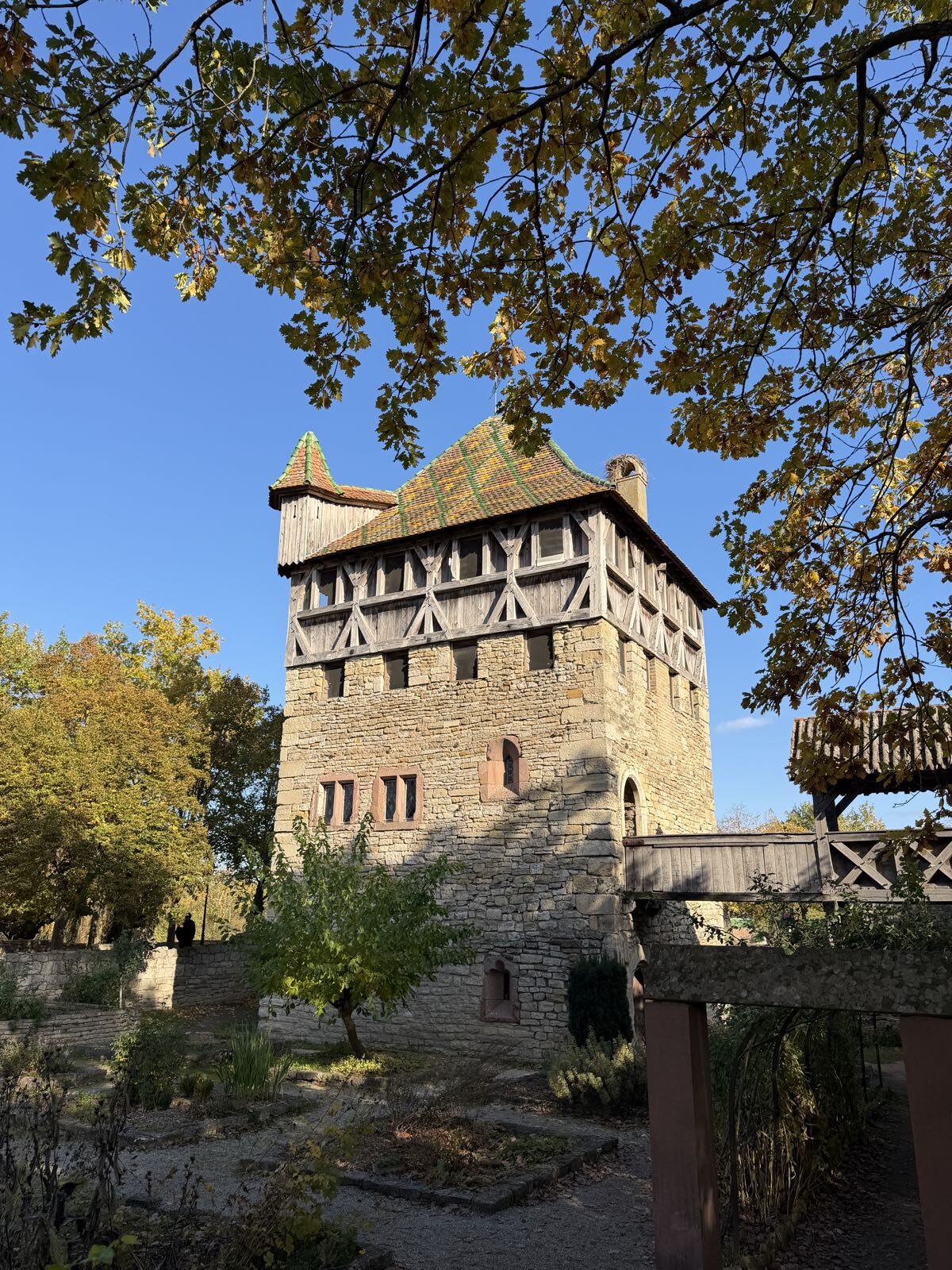
The site is large; we were there a good three hours and didn’t see all of it. The watermill by the pond and the fortified tower are the two spots where I stood the longest. Plan half a day rather than two hours, and bring sturdy shoes.

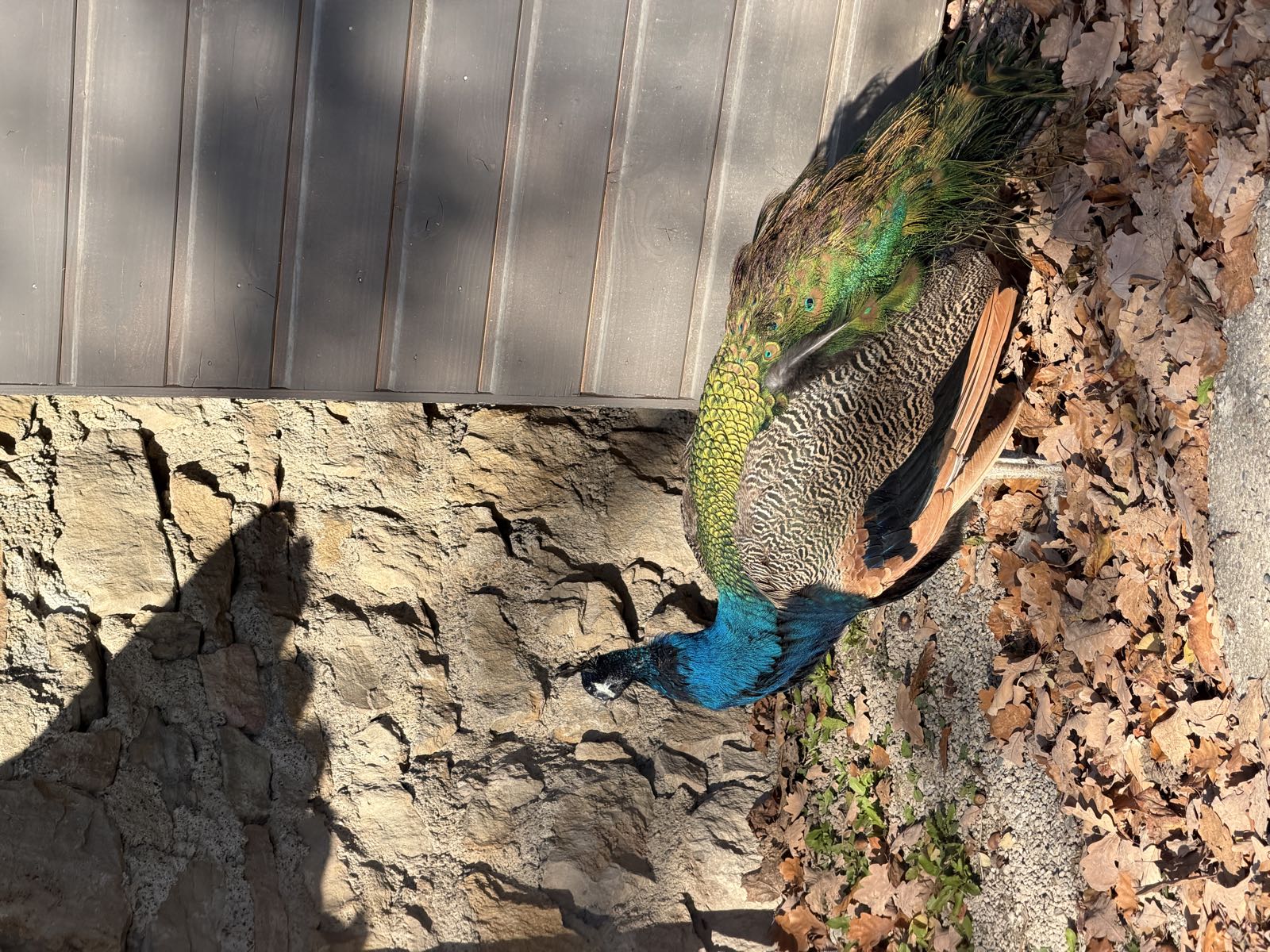
Animals roam freely between the houses: donkeys, geese, a peacock entirely unbothered by anyone. For children the museum is at least as interesting as the theme park next door, just without the queues.
Food and wine
Alsatian cooking is hearty, French-influenced and considerably closer to the German side than you’d think. That is no accident but the result of the history: sauerkraut and spätzle come from one side, technique and sauces from the other. Tarte flambée, baeckeoffe, choucroute, with Riesling and Gewürztraminer from the region. These were our four stops.
Zinc, Colmar
For lunch in Colmar we went to Zinc, a bistro in the middle of the old town. We ordered the obvious thing: tarte flambée. Thin dough, crème fraîche, onions, bacon, straight from the oven onto a board and into the middle of the table. Originally it was a by-product of baking bread: farmers’ wives slid a flat piece of dough into the oven to test whether the heat was right. What came out was eaten standing up, before the bread was even done.


It isn’t a place where you linger, and at lunchtime that was exactly right. The service is quick, the prices are fair, and for dessert there was coffee with something sweet before we moved on.
Domaine Schoenheitz, Wihr-au-Val
The Schoenheitz winery lies in the Munster valley, around 15 minutes west of Colmar. The family works the slopes above the village, and the vines here stand higher and steeper than on the flat stretch of the Alsace wine route. That wine grows here at all is not a given: the steep terraces in the valley were abandoned for decades because machines can’t work them. The family brought them back piece by piece.
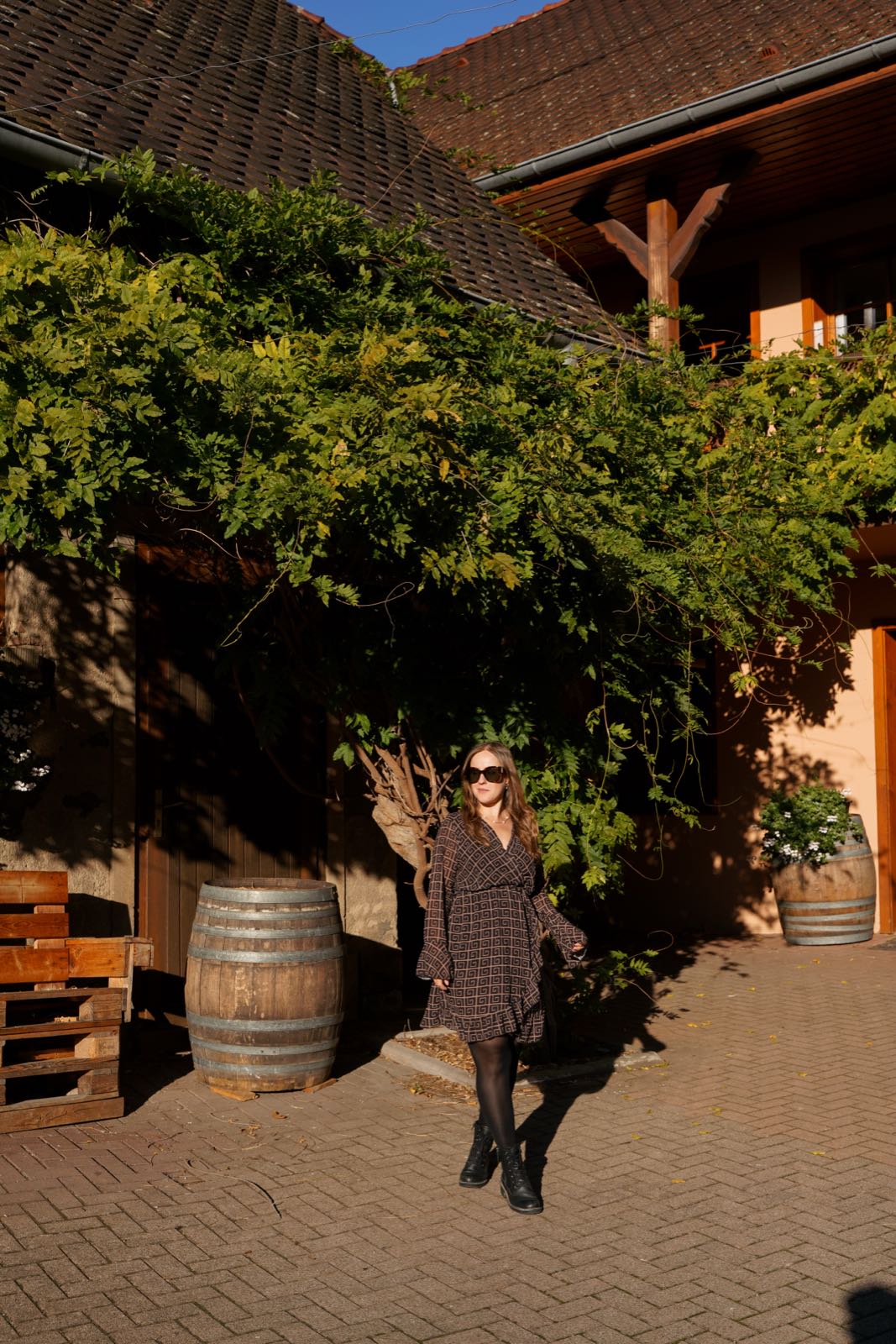
The tour runs through the cellar with the barrels and ends at the counter with the tasting. We tried Riesling, Pinot Gris and Gewürztraminer, all from the plots directly above the house. The difference between two wines from parcels only two hundred metres apart was clearer than I had expected.


What I liked: things get explained without anyone lecturing you. You can tell that a family has worked the same slope for generations, and that makes the wines more interesting than they could ever be on a shop shelf.
Le Petit Haslach

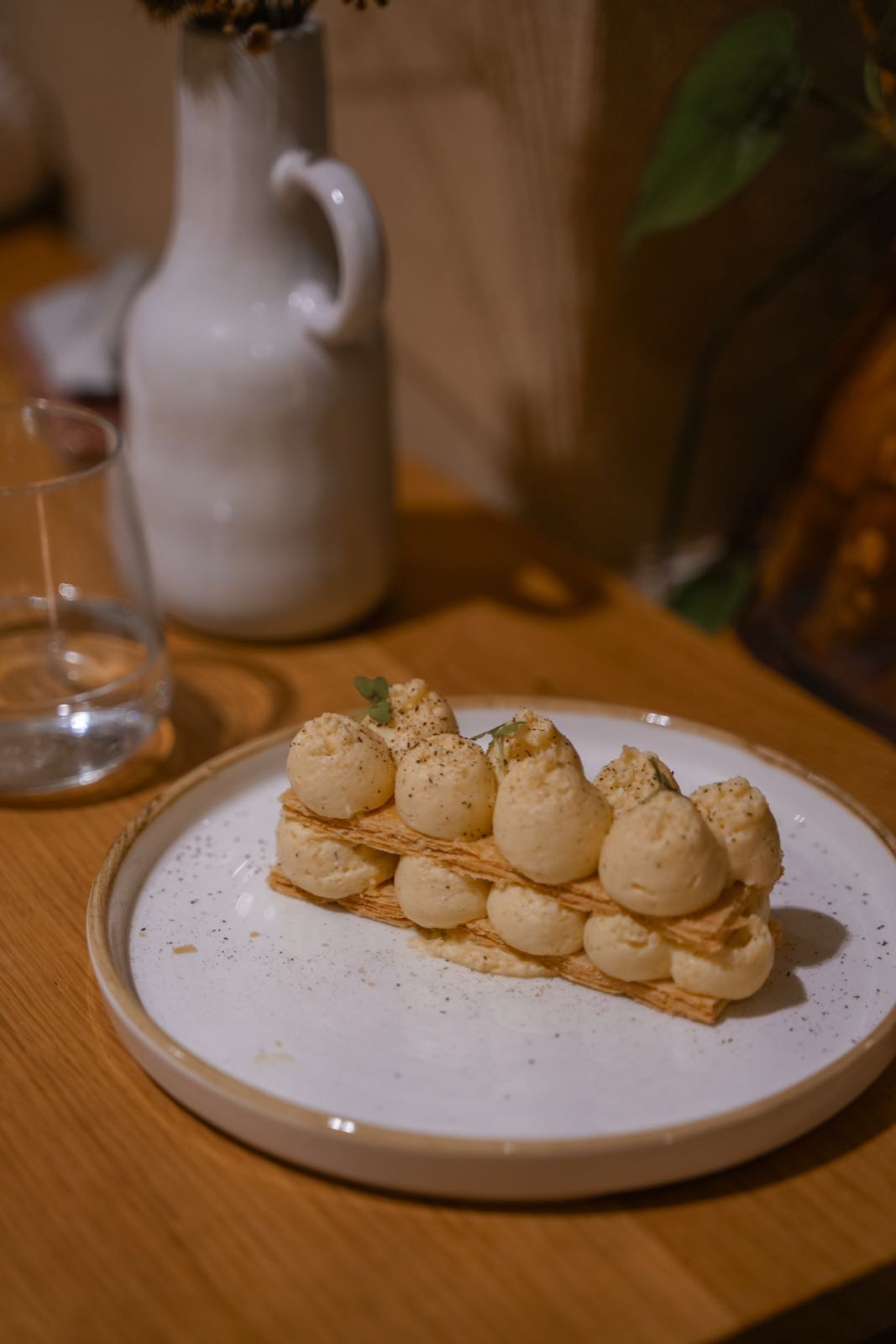
The restaurant belongs to the Domaine de Haslach and was our dinner on the first day. The menu is short, seasonal and Alsatian in character, with a set menu where you choose between two or three dishes per course. A short menu is almost always a good sign to me: it means things are cooked fresh rather than pulled out of a freezer.
It came as several courses: an amuse-bouche to start, then a main with mushrooms and sauce, with side dishes brought to the table in a bowl. Mushrooms in October aren’t decoration in Alsace, they’re the season: the Vosges forests start right behind the house.


After a long drive it was exactly right not to have to get back in the car. You walk down one flight of stairs from your room and you’re at the table, and with a baby that’s worth more than it sounds: if anything happens, you’re upstairs in two minutes.
La Châtaigneraie
The loveliest evening of the trip. The restaurant sits above the valley, and while the courses come out it slowly gets dark outside. The name means chestnut grove, and that is exactly what grows all around.

A multi-course menu is served, plated with a great deal of care: plates you look at for a moment before picking up your fork. The kitchen works in a classic French style, but without the heaviness. There is enough time between courses that dinner here really is the evening, rather than something you fit in beforehand.


We sat at the table for a good two hours and the baby slept beside us the whole time. Do book ahead, the room is small.
Where we stayed: Domaine de Haslach
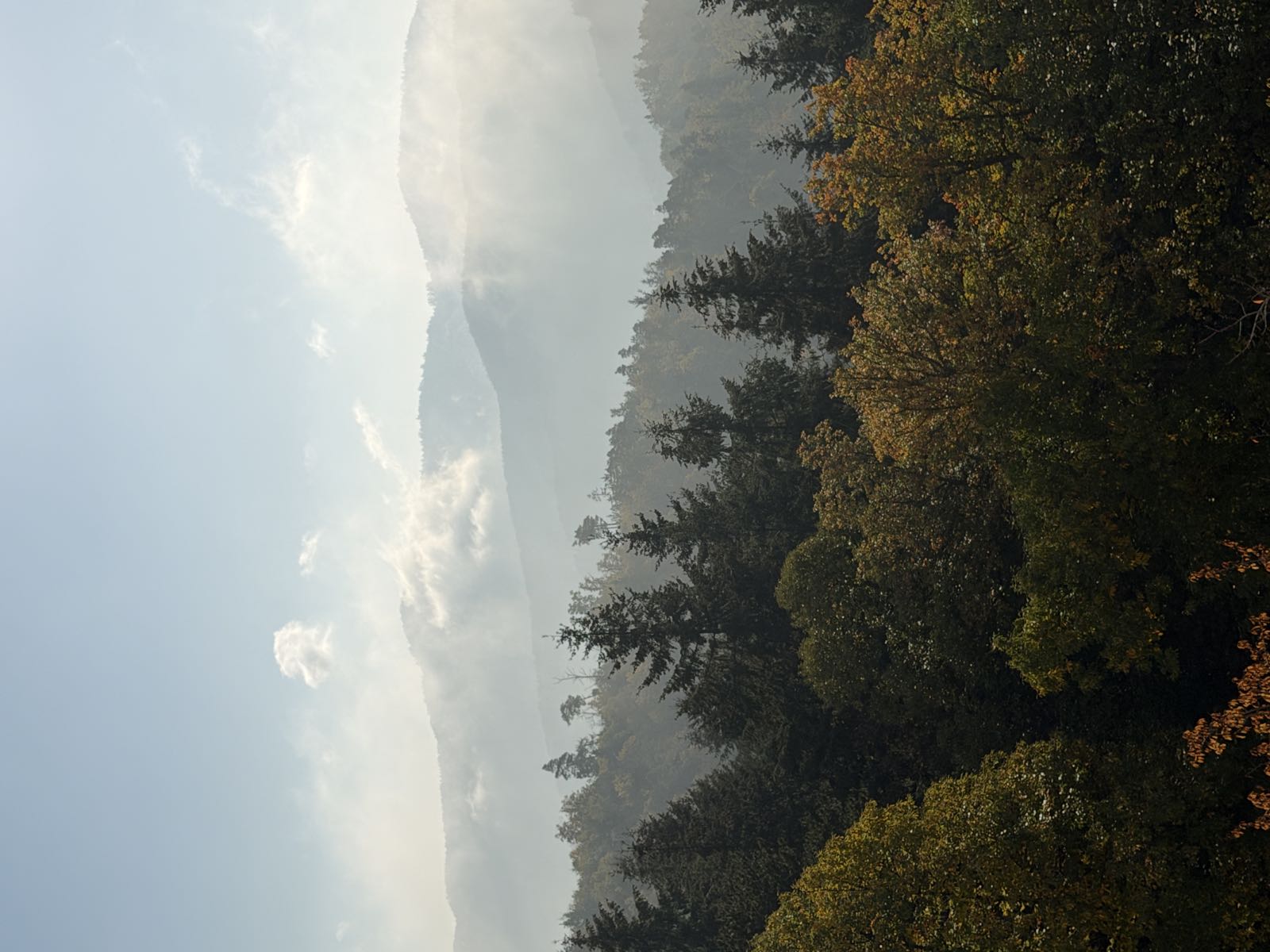
We stayed at the Domaine de Haslach in the Munster valley, around 20 minutes by car from Colmar. The house stands on the slope above the valley, and from our balcony the view ran across the hills to the Vosges. The location is the real reason to book here: close enough to Colmar for any day trip, and completely quiet in the evening.

The apartment
We had an apartment rather than a hotel room, and with children that makes all the difference. There’s a living area with a sofa, a dining area with a table, a bedroom for the adults and a second one with a bunk bed for the children. Plus a small kitchenette.


The separate room for the children was the most useful part. Once they’re asleep you can sit in the living area without whispering. Anyone who has ever lain in a dark hotel room at eight in the evening with their phone knows what I mean. We barely used the kitchenette, but warming milk and keeping something cold: that alone justifies the extra cost.


A Crémant d’Alsace was waiting on the table when we arrived, with something to nibble. A small thing, but it sets the tone for the stay. Crémant isn’t a second-best product in Alsace, by the way; it’s a category of its own with protected origin, made by the same method as champagne.


Breakfast
Breakfast was the loveliest part of the stay for me, and I say that as someone who really only wants coffee in the morning. It’s served in the restaurant with the big windows onto the valley. There’s a buffet with fresh bread, butter, jams, honey, cheese and charcuterie from the region, plus fruit, yoghurt and pastries. Croissants and hot drinks come to the table.


What makes it special isn’t the selection, it’s the pace. Nobody rushes you, the tables are far apart, and outside the morning mist lifts off the valley while you drink your second coffee. We sat at that table for over an hour both mornings. That is the opposite of the breakfast you normally get with a small child, and it is exactly why it stayed with me.
Spa and pool
There’s a spa area with a pool in the house. Not an infinity pool overlooking the valley, but an indoor pool with wood on the walls and a painted sky on the ceiling. That sounds twee-er than it is: when you’re the only one in the water in the evening, it works.

There’s a sauna and a quiet room as well. After a day at the Écomusée pushing a pram over cobblestones, that was the right order of things: into the water first, then dinner.
Alsace with a baby and a pram
We travelled with a baby, and that shaped the trip without limiting it. What worked and what didn’t:
- Colmar: The old town is car-free and flat, but the cobbles are rough. A pram with big wheels is far more comfortable than a buggy.
- Écomusée: Some of the paths are unpaved and the site is large. Doable with a pram, but allow time.
- Parc du Petit Prince: The most straightforward place of the whole trip. Wide paths, changing facilities, shade.
- Restaurants: No trouble anywhere. Not one of them so much as blinked when we came in with the pram.
- Accommodation: With a child, an apartment instead of a room is worth every extra franc.
- The drive: Two and a half hours from Lucerne is manageable with a baby if you plan a stop. We broke the journey briefly in Basel.
Tips for your trip
- Be in Colmar early. Between nine and eleven, Petite Venise is almost yours alone.
- Two nights aren’t enough. We had two and had to rush the Écomusée. Three is more honest.
- Book restaurants, especially outside Colmar. The rooms are small and full at weekends.
- Carry cash. At the winery and smaller stalls, cards aren’t a given everywhere.
- Autumn over summer. In October you get the leaves, the pumpkins and half as many people.
- Don’t stop at Colmar. The Munster valley and Ungersheim are the reason the car is worth it.
- No vignette needed. In France you pay tolls at the barrier, and on this route there is hardly any.
Final thoughts
Alsace is the opposite of a complicated trip. Two and a half hours from Lucerne, no flights, no time difference, and it still feels like abroad. Colmar is beautiful enough to justify the drive on its own, but what stayed with us are the places around it: the village at the Écomusée, the slope above Wihr-au-Val, the valley in the morning mist seen from the breakfast table.
We’ll be back, and for longer next time.
More about the region from the Agence Régionale du Tourisme Grand Est: explore-grandest.com, on Instagram @exploregrandest.officiel.